|
LEGAL EAGLE EYE NEWSLETTER For the Nursing Profession Request a complimentary copy of our current newsletter What is our mission? What publication formats are available? How do I start a subscription? Can I cancel and get a refund? Does my subscription renew automatically? |
| WHAT IS OUR MISSION? |
| Our mission is to reduce nurses' fear of the law and to minimize nurses' exposure to litigation. Nurse managers need to spot potential legal problems and prevent them before they happen. Managers and clinical nurses need to be familiar with how the law is applied by the courts to specific patient-care situations, so that they can act with confidence. |
|
We work
toward our goals every month by highlighting the very latest
important Federal and state court decisions and new Federal
regulations directly affecting nurses in hospitals, long term care
facilities and home health agencies. We focus on nursing negligence
and nurses' employment and licensing issues.
|
|
WHAT PUBLICATION FORMATS ARE AVAILABLE? |
|
The Email
Edition is our most popular format.
You receive the newsletter as a PDF file attachment in an email
sent to you every month. On
any computer or mobile device you simply click the file attachment to
open, read, download, and/or print the newsletter. |
|
The Email
Edition is ideally suited to individuals.
It can also be used by large institutions.
Within an institution, like a hospital or university nursing
department, an individual subscriber can forward pertinent articles to
colleagues within the institution.
The content cannot be forwarded outside the institution or posted
online. An example
might be a nursing director or director of nursing education who shares
articles with nurse managers in individual clinical departments |
|
The Online Edition is a format suited to educational and healthcare
facility libraries with multiple users.
We send a link via email for the current monthly newsletter.
To open the link to the newsletter for that month the subscriber
or other user must be using a computer or device whose IP address or
range of IP addresses we have authenticated and given permission for
online access. |
|
Print, Email and Online
formats contain exactly the same content, eight pages with no
advertising. |
|
The links below go to secure online sites maintained for
us by Square, Inc. for credit and debit card purchases.
At checkout you will provide your name, payment information and email address. |
Email Subscription $120/year |
|
Print / Print + Email Subscription $155/year |
|
If you prefer, you can download and print an order form to mail
or to scan and email to us.
Checks, credit and debit cards, purchase orders accepted, or we will
bill you. |
|
CAN I CANCEL MY SUBSCRIPTION AND GET A REFUND? |
|
Yes. Just ask and the
unused portion of your subscription will be refunded. |
|
DOES MY SUBSCRIPTION RENEW AUTOMATICALLY? |
| No. Before your annual subscription runs out you will receive a renewal notice by email and regular mail. |
Legal Eagle Eye Newsletter
For the Nursing Profession
PO Box 1342 Sedona AZ 86339
(206) 718-0861
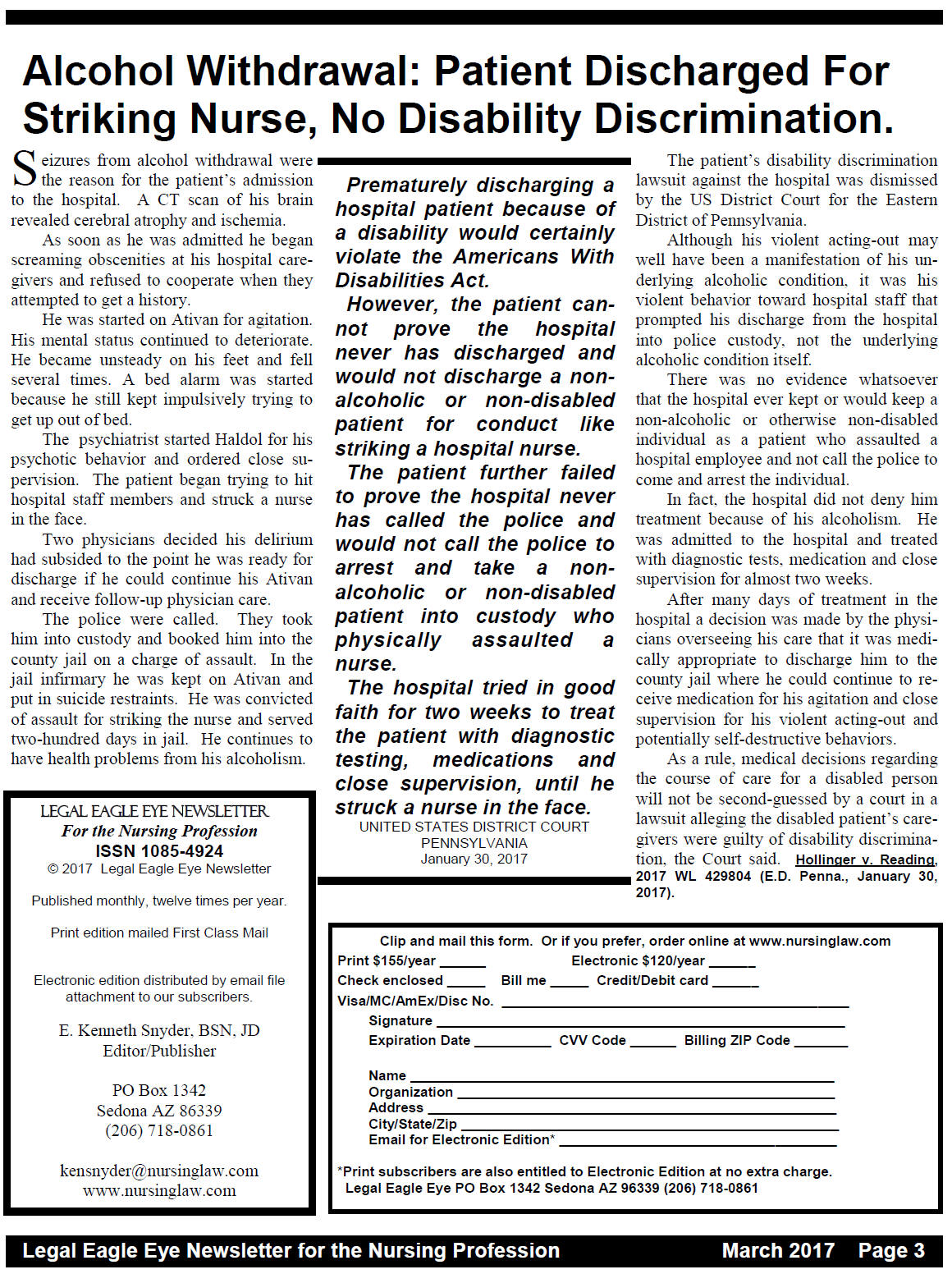
Alcohol Withdrawal: Patient Discharged For Striking Nurse, No Disability Discrimination.
Prematurely discharging a hospital patient because of a disability would certainly violate the Americans With Disabilities Act. However, the patient cannot prove the hospital never has discharged and would not discharge a non-alcoholic or non-disabled patient for conduct like striking a hospital nurse. The patient further failed to prove the hospital never has called the police and would not call the police to arrest and take a non-alcoholic or non-disabled patient into custody who physically assaulted a nurse.
The hospital tried in good faith for two weeks to treat the patient with diagnostic testing, medications and close supervision, until he struck a nurse in the face.
UNITED STATES DISTRICT COURT PENNSYLVANIA January 30, 2017Seizures from alcohol withdrawal were the reason for the patient’s admission to the hospital. A CT scan of his brain revealed cerebral atrophy and ischemia. As soon as he was admitted he began screaming obscenities at his hospital caregivers and refused to cooperate when they attempted to get a history.
He was started on Ativan for agitation. His mental status continued to deteriorate. He became unsteady on his feet and fell several times. A bed alarm was started because he still kept impulsively trying to get up out of bed. The psychiatrist started Haldol for his psychotic behavior and ordered close supervision. The patient began trying to hit hospital staff members and struck a nurse in the face.
Two physicians decided his delirium had subsided to the point he was ready for discharge if he could continue his Ativan and receive follow-up physician care. The police were called. They took him into custody and booked him into the county jail on a charge of assault. In the jail infirmary he was kept on Ativan and put in suicide restraints. He was convicted of assault for striking the nurse and served two-hundred days in jail. He continues to have health problems from his alcoholism.
The patient’s disability discrimination lawsuit against the hospital was dismissed by the US District Court for the Eastern District of Pennsylvania. Although his violent acting-out may well have been a manifestation of his underlying alcoholic condition, it was his violent behavior toward hospital staff that prompted his discharge from the hospital into police custody, not the underlying alcoholic condition itself.
There was no evidence whatsoever that the hospital ever kept or would keep a non-alcoholic or otherwise non-disabled individual as a patient who assaulted a hospital employee and not call the police to come and arrest the individual. In fact, the hospital did not deny him treatment because of his alcoholism. He was admitted to the hospital and treated with diagnostic tests, medication and close supervision for almost two weeks. After many days of treatment in the hospital a decision was made by the physicians overseeing his care that it was medically appropriate to discharge him to the county jail where he could continue to receive medication for his agitation and close supervision for his violent acting-out and potentially self-destructive behaviors. As a rule, medical decisions regarding the course of care for a disabled person will not be second-guessed by a court in a lawsuit alleging the disabled patient’s caregivers were guilty of disability discrimination, the Court said.
Hollinger v. Hospital, 2017 WL 429804 (E.D. Penna., January 30, 2017).Additional references from nursinglaw.com
http://www.nursinglaw.com/abuse-patient.htm
http://www.nursinglaw.com/excessive-force-police-nurse.htm
http://www.nursinglaw.com/suicidal-mental-health-commitment.htm
http://www.nursinglaw.com/search-patient-property.htm
http://www.nursinglaw.com/arrest-warrant-patient.htm
http://www.nursinglaw.com/psychiatric-hold-nurse-negligence.htm
http://www.nursinglaw.com/mental-health-custody-control.htm
http://www.nursinglaw.com/hostage-drill-nursing-home.htm
http://www.nursinglaw.com/hospital-family-belligerent.htm
http://www.nursinglaw.com/forced-catheterization.htm
http://www.nursinglaw.com/emergency-department-nurse.htm