|
LEGAL EAGLE EYE NEWSLETTER For the Nursing Profession Request a complimentary copy of our current newsletter What is our mission? What publication formats are available? How do I start a subscription? Can I cancel and get a refund? Does my subscription renew automatically? |
| WHAT IS OUR MISSION? |
| Our mission is to reduce nurses' fear of the law and to minimize nurses' exposure to litigation. Nurse managers need to spot potential legal problems and prevent them before they happen. Managers and clinical nurses need to be familiar with how the law is applied by the courts to specific patient-care situations, so that they can act with confidence. |
|
We work
toward our goals every month by highlighting the very latest
important Federal and state court decisions and new Federal
regulations directly affecting nurses in hospitals, long term care
facilities and home health agencies. We focus on nursing negligence
and nurses' employment and licensing issues.
|
|
WHAT PUBLICATION FORMATS ARE AVAILABLE? |
|
The Email
Edition is our most popular format.
You receive the newsletter as a PDF file attachment in an email
sent to you every month. On
any computer or mobile device you simply click the file attachment to
open, read, download, and/or print the newsletter. |
|
The Email
Edition is ideally suited to individuals.
It can also be used by large institutions.
Within an institution, like a hospital or university nursing
department, an individual subscriber can forward pertinent articles to
colleagues within the institution.
The content cannot be forwarded outside the institution or posted
online. An example
might be a nursing director or director of nursing education who shares
articles with nurse managers in individual clinical departments |
|
The Online Edition is a format suited to educational and healthcare
facility libraries with multiple users.
We send a link via email for the current monthly newsletter.
To open the link to the newsletter for that month the subscriber
or other user must be using a computer or device whose IP address or
range of IP addresses we have authenticated and given permission for
online access. |
|
Print, Email and Online
formats contain exactly the same content, eight pages with no
advertising. |
|
The links below go to secure online sites maintained for
us by Square, Inc. for credit and debit card purchases.
At checkout you will provide your name, payment information and email address. |
Email Subscription $120/year |
|
Print / Print + Email Subscription $155/year |
|
If you prefer, you can download and print an order form to mail
or to scan and email to us.
Checks, credit and debit cards, purchase orders accepted, or we will
bill you. |
|
CAN I CANCEL MY SUBSCRIPTION AND GET A REFUND? |
|
Yes. Just ask and the
unused portion of your subscription will be refunded. |
|
DOES MY SUBSCRIPTION RENEW AUTOMATICALLY? |
| No. Before your annual subscription runs out you will receive a renewal notice by email and regular mail. |
Legal Eagle Eye Newsletter
For the Nursing Profession
PO Box 1342 Sedona AZ 86339
(206) 718-0861
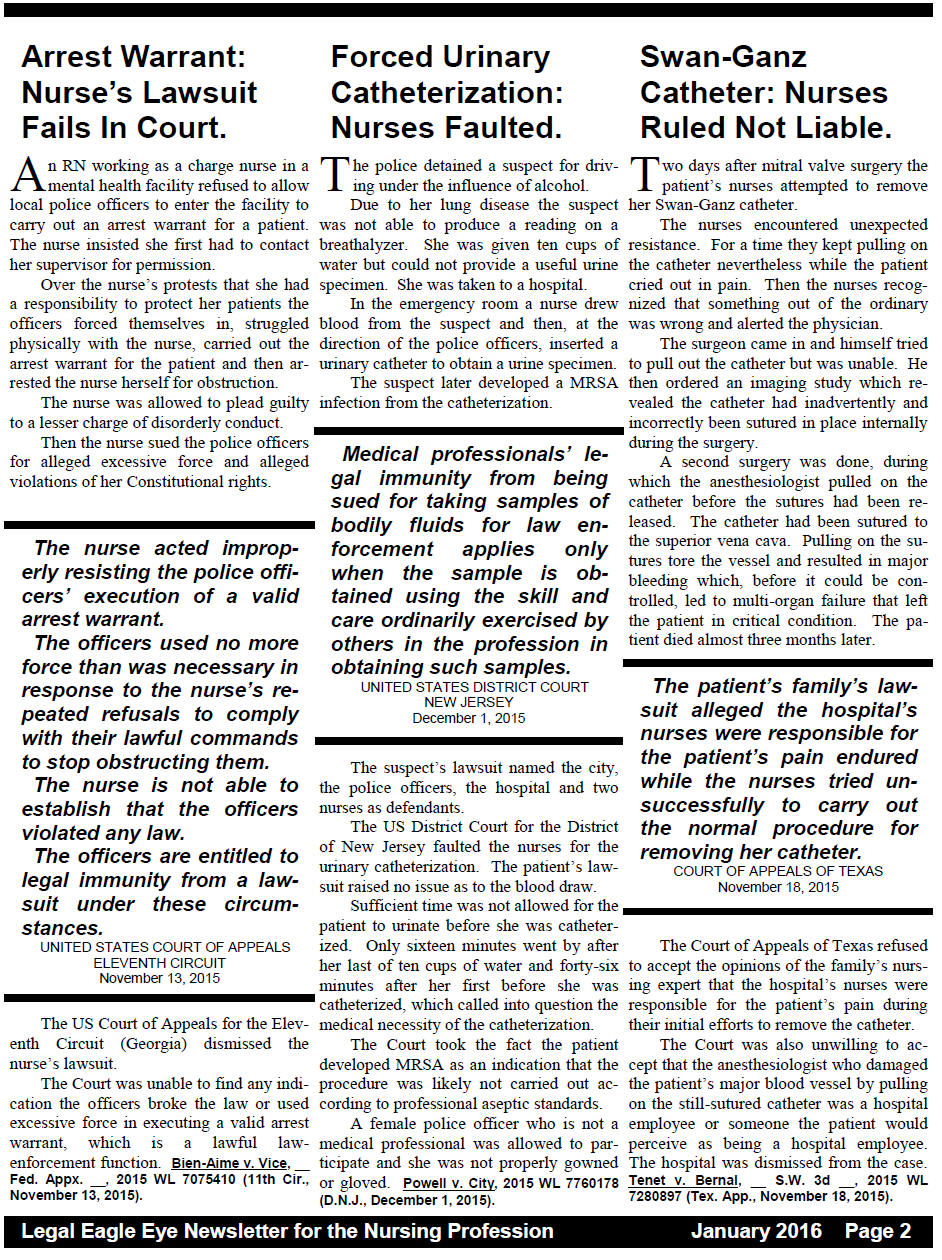
Forced Urinary Catheterization: Nurses Faulted.
Medical professionals' legal immunity from being sued for taking samples of bodily fluids for law enforcement applies only when the sample is obtained using the skill and care ordinarily exercised by others in the profession in obtaining such samples.
UNITED STATES DISTRICT COURT NEW JERSEY December 1, 2015The police detained a suspect for driving under the influence of alcohol. Due to her lung disease the suspect was not able to produce a reading on a breathalyzer. She was given ten cups of water but could not provide a useful urine specimen. She was taken to a hospital. In the emergency room a nurse drew blood from the suspect and then, at the direction of the police officers, inserted a urinary catheter to obtain a urine specimen. The suspect later developed a MRSA infection from the catheterization.
The suspect's lawsuit named the city, the police officers, the hospital and two nurses as defendants. The US District Court for the District of New Jersey faulted the nurses for the urinary catheterization. The patient's lawsuit raised no issue as to the blood draw. Sufficient time was not allowed for the patient to urinate before she was catheterized. Only sixteen minutes went by after her last of ten cups of water and forty-six minutes after her first before she was catheterized, which called into question the medical necessity of the catheterization. The Court took the fact the patient developed MRSA as an indication that the procedure was likely not carried out according to professional aseptic standards. A female police officer who is not a medical professional was allowed to participate and she was not properly gowned or gloved.
Powell v. City, 2015 WL 7760178 (D.N.J., December 1, 2015).