|
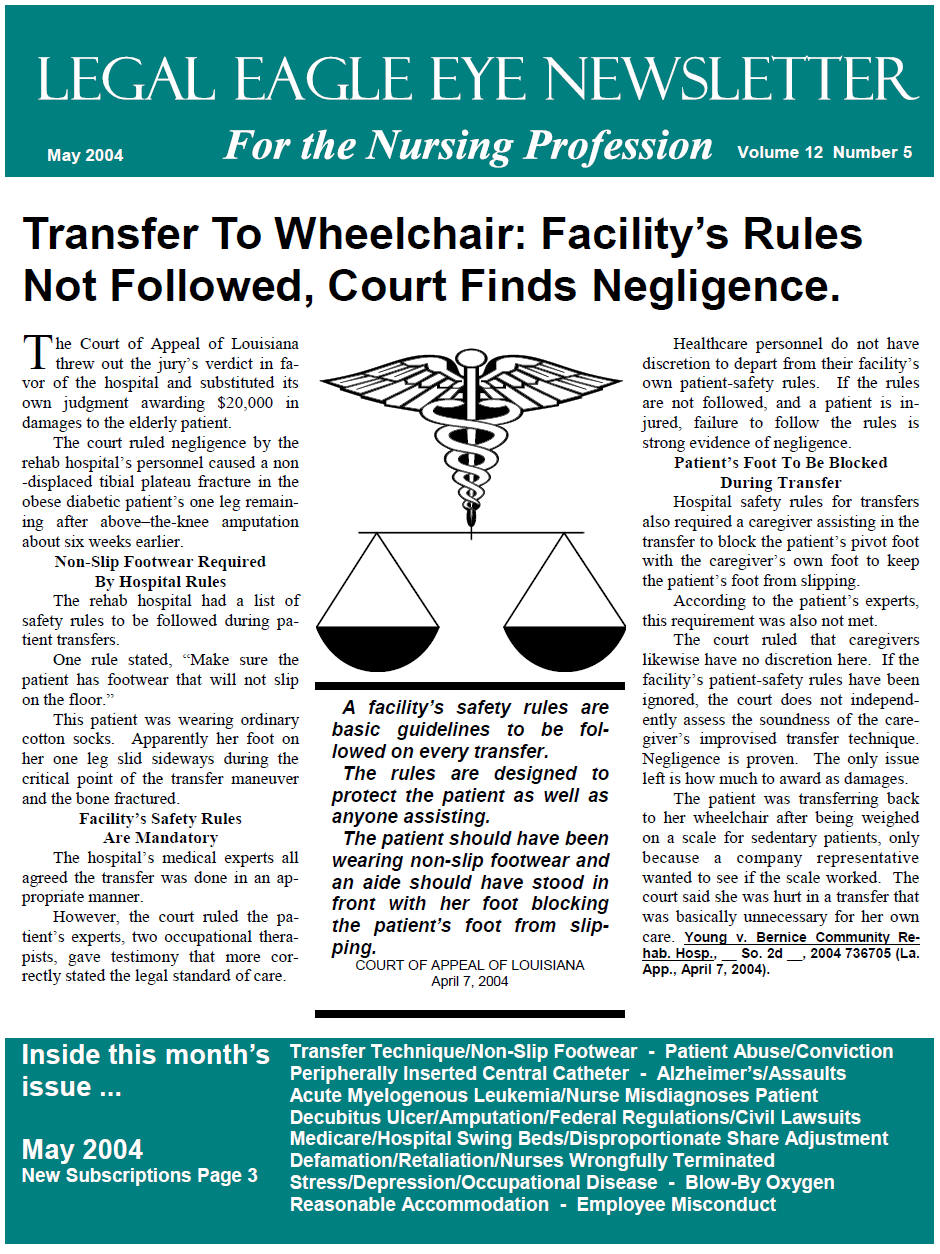
LEGAL EAGLE EYE NEWSLETTER For the Nursing Profession Request a complimentary copy of our current newsletter What is our mission? What publication formats are available? How do I start a subscription? Can I cancel and get a refund? Does my subscription renew automatically? |
| WHAT IS OUR MISSION? |
| Our mission is to reduce nurses' fear of the law and to minimize nurses' exposure to litigation. Nurse managers need to spot potential legal problems and prevent them before they happen. Managers and clinical nurses need to be familiar with how the law is applied by the courts to specific patient-care situations, so that they can act with confidence. |
|
We work
toward our goals every month by highlighting the very latest
important Federal and state court decisions and new Federal
regulations directly affecting nurses in hospitals, long term care
facilities and home health agencies. We focus on nursing negligence
and nurses' employment and licensing issues.
|
|
WHAT PUBLICATION FORMATS ARE AVAILABLE? |
|
The Email
Edition is our most popular format.
You receive the newsletter as a PDF file attachment in an email
sent to you every month. On
any computer or mobile device you simply click the file attachment to
open, read, download, and/or print the newsletter. |
|
The Email
Edition is ideally suited to individuals.
It can also be used by large institutions.
Within an institution, like a hospital or university nursing
department, an individual subscriber can forward pertinent articles to
colleagues within the institution.
The content cannot be forwarded outside the institution or posted
online. An example
might be a nursing director or director of nursing education who shares
articles with nurse managers in individual clinical departments |
|
The Online Edition is a format suited to educational and healthcare
facility libraries with multiple users.
We send a link via email for the current monthly newsletter.
To open the link to the newsletter for that month the subscriber
or other user must be using a computer or device whose IP address or
range of IP addresses we have authenticated and given permission for
online access. |
|
Print, Email and Online
formats contain exactly the same content, eight pages with no
advertising. |
|
The links below go to secure online sites maintained for
us by Square, Inc. for credit and debit card purchases.
At checkout you will provide your name, payment information and email address. |
Email Subscription $120/year |
|
Print / Print + Email Subscription $155/year |
|
If you prefer, you can download and print an order form to mail
or to scan and email to us.
Checks, credit and debit cards, purchase orders accepted, or we will
bill you. |
|
CAN I CANCEL MY SUBSCRIPTION AND GET A REFUND? |
|
Yes. Just ask and the
unused portion of your subscription will be refunded. |
|
DOES MY SUBSCRIPTION RENEW AUTOMATICALLY? |
| No. Before your annual subscription runs out you will receive a renewal notice by email and regular mail. |
Legal Eagle Eye Newsletter
For the Nursing Profession
PO Box 1342 Sedona AZ 86339
(206) 718-0861
Osteoporosis: Nurses Break Patient's Legs In Transfer - Substantial Verdict
Quick Summary: The patient’s life took a tragic turn for the worse when the nurses broke both her legs transferring her from her bed to her wheelchair.
The hospital contended the verdict of $1,250,000 in the patient’s favor was not supported by the evidence and was unjust.
First, she experienced extreme pain during the transfer. She became nauseous and sweaty and blacked out. Then she was left unattended in the hall and later was found slumped in her wheelchair.
She waited several hours for hospital personnel to discover her right leg was broken.
She suffered until the next day before anyone at the hospital noticed that her left leg was also broken.
Clearly this patient experienced extreme pain and anxiety during this time, especially in light of the fact that she entered the hospital to gain mobility and independence, not to lose it.
COURT OF APPEALS OF TEXAS, 1998.The patient was seventy-one years old. She suffered from rheumatoid arthritis and had osteoporosis. She could stand with a walker, but she could not walk. She could sit for up to two hours and could ride in a car.
She had had both her hips replaced. Her physician believed replacing both her knees would improve her mobility. He had her admitted to a rehab facility for physical therapy to improve her mobility prior to knee-replacement surgery. Over the next several days she was seen by the orthopedic surgeons. They decided she was not an acceptable candidate for knee replacement.
She stayed at the rehab facility anyway. The orthopedists and her physician worked out a treatment plan to be followed in the rehab facility aimed at increasing her mobility short of restoring the ability to ambulate independently.
Eleven days into her stay, however, both her legs were broken, each in two places, by the facility’s nurses while attempting to transfer the patient from her bed to a wheelchair. She ended up in full leg casts for two months. Afterward she could no longer stand even with a walker, could not sit for more than twenty minutes and essentially had to spend the rest of her life prone in bed.
She sued the rehab facility for the nurses’ negligence. She also sued her physician for a consumer protection violation for misrepresenting that she was a good candidate for knee replacement. The physician paid a nominal $15,000 settlement. The case went to trial against the hospital, and the jury returned a verdict of $1,250,000, which the judge reduced to $1,235,000 to account for the $15,000 settlement from the physician. The Court of Appeals of Texas ruled the jury’s substantial verdict was just and proper.
Rehab v. Cooper, 962 S.W. 2d 151 (Tex. App., 1998).More references from nursinglaw.com
http://www.nursinglaw.com/transfer-unsafe.htm
http://www.nursinglaw.com/assistance-to-transfer.htm
http://www.nursinglaw.com/transfer-wheelchair-negligence.pdf
http://www.nursinglaw.com/transfer-technique-nursing-negligence.pdf
http://www.nursinglaw.com/transfer2.htm