LEGAL EAGLE EYE NEWSLETTER
For the Nursing Profession


Request a complimentary copy
of our current newsletter


What is our mission?

What publication formats are available?

How do I start a subscription?

Can I cancel and get a refund?

Does my subscription renew automatically?


WHAT IS OUR MISSION?
      Our mission is to reduce nurses' fear of the law and to minimize nurses' exposure to litigation.  Nurse managers need to spot potential legal problems and prevent them before they happen. Managers and clinical nurses need to be familiar with how the law is applied by the courts to specific patient-care situations, so that they can act with confidence.  
    We work toward our goals every month by highlighting the very latest important Federal and state court decisions and new Federal regulations directly affecting nurses in hospitals, long term care facilities and home health agencies. We focus on nursing negligence and nurses' employment and licensing issues.    Our readers are professionals in nursing management, nursing education, clinical nursing, healthcare risk management, legal nurse consulting and law.

WHAT PUBLICATION FORMATS ARE AVAILABLE?
     The Email Edition is our most popular format.  You receive the newsletter as a PDF file attachment in an email sent to you every month.  On any computer or mobile device you simply click the file attachment to open, read, download, and/or print the newsletter. 
    The Email Edition is ideally suited to individuals.  It can also be used by large institutions.  Within an institution, like a hospital or university nursing department, an individual subscriber can forward pertinent articles to colleagues within the institution.  The content cannot be forwarded outside the institution or posted online.   An example might be a nursing director or director of nursing education who shares articles with nurse managers in individual clinical departments.
   The Online Edition is a format suited to educational and healthcare facility libraries with multiple users.  We send a link via email for the current monthly newsletter.  To open the link to the newsletter for that month the subscriber or other user must be using a computer or device whose IP address or range of IP addresses we have authenticated and given permission for online access.
     Print, Email and Online formats contain exactly the same content, eight pages with no advertising.

HOW DO I START A SUBSCRIPTION?

    The links below go to secure online sites maintained for us by Square, Inc. for credit and debit card purchases.  At checkout you will provide your name, payment information and email address.

Email Subscription $120/year

Print / Print + Email Subscription $155/year


     If you prefer, you can download and print an order form to mail or to scan and email to us.  Checks, credit and debit cards, purchase orders accepted, or we will bill you.  Order Form

CAN I CANCEL MY SUBSCRIPTION AND GET A REFUND?
     Yes. Just ask and the unused portion of your subscription will be refunded.

DOES MY SUBSCRIPTION RENEW AUTOMATICALLY?
     No. Before your annual subscription runs out you will receive a renewal notice by email and regular mail.


Legal Eagle Eye Newsletter

For the Nursing Profession

PO Box 1342 Sedona AZ 86339

(206) 718-0861 


info@nursinglaw.com 

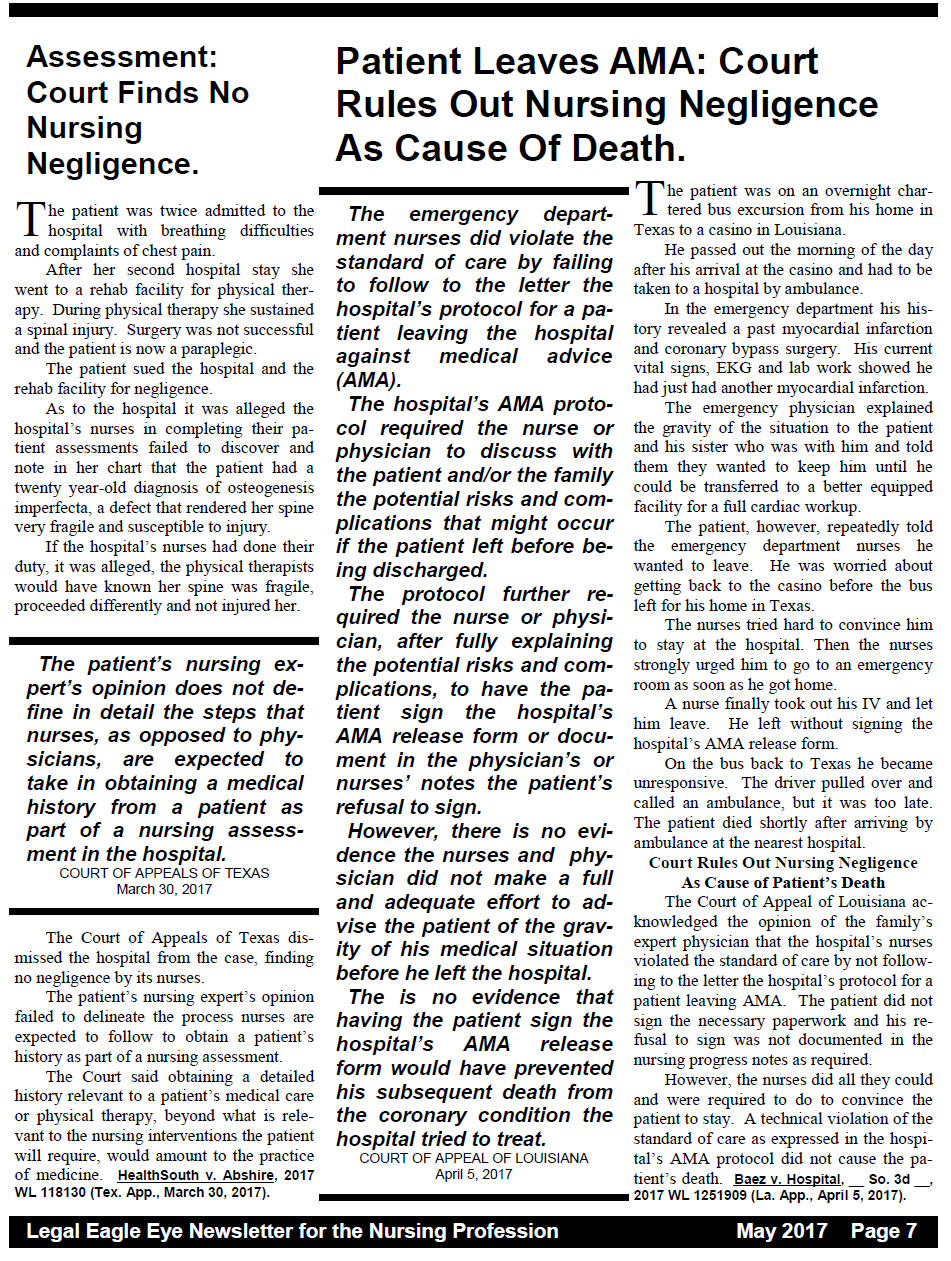
Patient Leaves AMA: Court Rules Out Nursing Negligence As Cause Of Death.

  The emergency department nurses did violate the standard of care by failing to follow to the letter the hospital's protocol for a patient leaving the hospital against medical advice (AMA).  The hospital's AMA protocol required the nurse or physician to discuss with the patient and/or the family the potential risks and complications that might occur if the patient left before being discharged. The protocol further required the nurse or physician, after fully explaining the potential risks and complications, to have the patient sign the hospital's AMA release form or document in the physician's or nurses' notes the patient's refusal to sign.

  However, there is no evidence the nurses and physician did not make a full and adequate effort to ad-vise the patient of the gravity of his medical situation before he left the hospital.  The is no evidence that having the patient sign the hospital's AMA release form would have prevented his subsequent death from the coronary condition the hospital tried to treat. COURT OF APPEAL OF LOUISIANA April 5, 2017    

    The patient was on an overnight chartered bus excursion from his home in Texas to a casino in Louisiana.  He passed out the morning of the day after his arrival at the casino and had to be taken to a hospital by ambulance.  In the emergency department his history revealed a past myocardial infarction and coronary bypass surgery.  His current vital signs, EKG and lab work showed he had just had another myocardial infarction.

    The emergency physician explained the gravity of the situation to the patient and his sister who was with him and told them they wanted to keep him until he could be transferred to a better equipped facility for a full cardiac workup. The patient, however, repeatedly told the emergency department nurses he wanted to leave.  He was worried about getting back to the casino before the bus left for his home in Texas.  The nurses tried hard to convince him to stay at the hospital.  Then the nurses strongly urged him to go to an emergency room as soon as he got home.  A nurse finally took out his IV and let him leave.   He left without signing the hospital's AMA release form.

    On the bus back to Texas he became unresponsive.  The driver pulled over and called an ambulance, but it was too late.  The patient died shortly after arriving by ambulance at the nearest hospital.

    The Court of Appeal of Louisiana acknowledged the opinion of the family's expert physician that the hospital's nurses violated the standard of care by not following to the letter the hospital's protocol for a patient leaving AMA.  The patient did not sign the necessary paperwork and his refusal to sign was not documented in the nursing progress notes as required.  However, the nurses did all they could and were required to do to convince the patient to stay.  A technical violation of the standard of care as expressed in the hospital's AMA protocol did not cause the patient's death. Baez v. Hospital, __ So. 3d __, 2017 WL 1251909 (La. App., April 5, 2017).