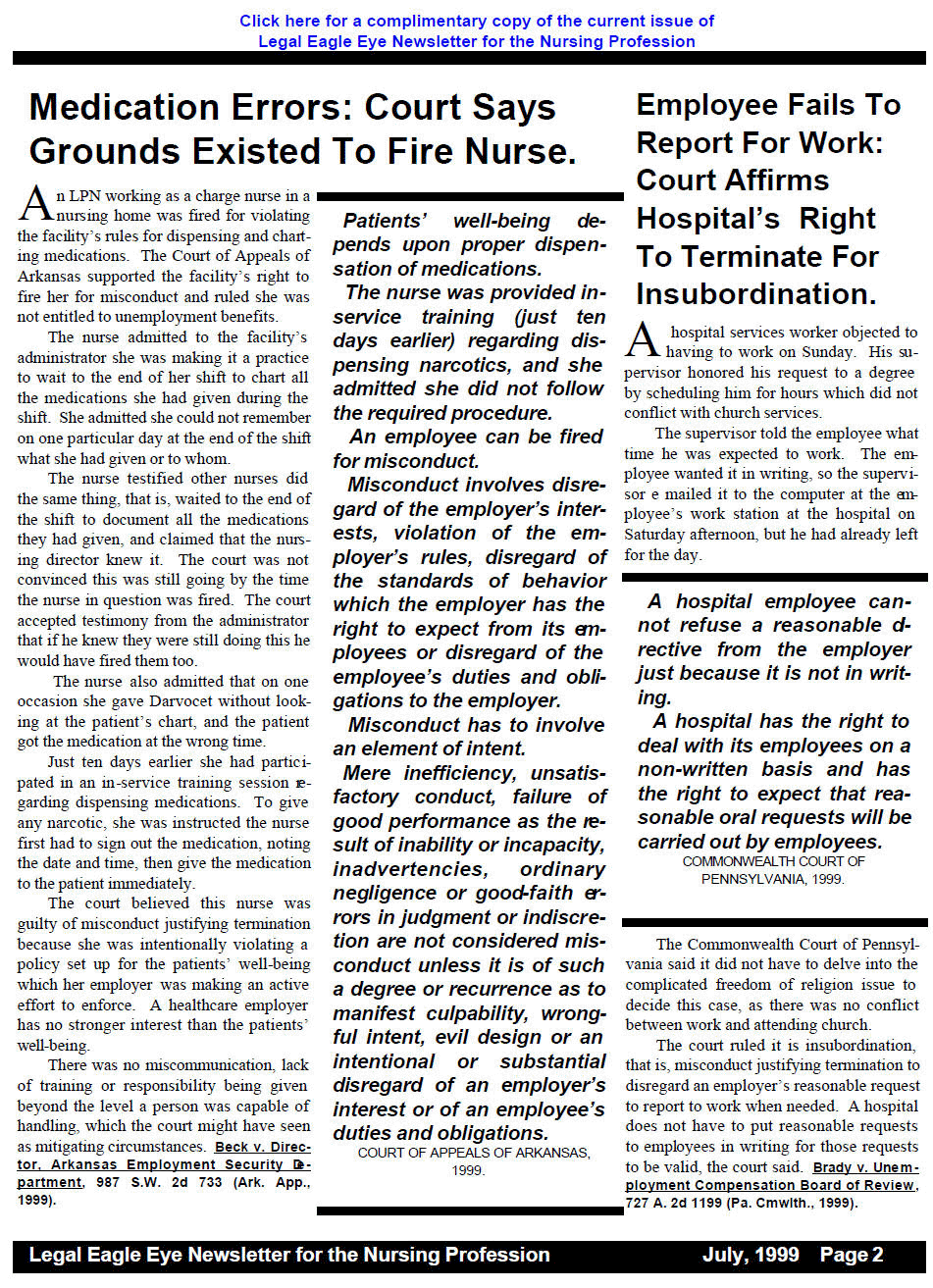
Quick Summary: Patients’ well-being depends upon proper dispensation of medications.
The nurse was provided in-service training (just ten days earlier) regarding dispensing narcotics, and she admitted she did not follow the required procedure.
An employee can be fired for misconduct.
Misconduct involves disregard of the employer’s interests, violation of the employer’s rules, disregard of the standards of behavior which the employer has the right to expect from its employees or disregard of the employee’s duties and obligations to the employer.
Misconduct has to involve an element of intent.
Mere inefficiency, unsatisfactory conduct, failure of good performance as the result of inability or incapacity, inadvertencies, ordinary negligence or good-faith errors in judgment or indiscretion are not considered misconduct unless it is of such a degree or recurrence as to manifest culpability, wrongful intent, evil design or an intentional or substantial disregard of an employer’s interest or of an employee’s duties and obligations. COURT OF APPEALS OF ARKANSAS, 1999.
An LPN working as a charge nurse in a nursing home was fired for violating the facility’s rules for dispensing and charting medications. The Court of Appeals of Arkansas supported the facility’s right to fire her for misconduct and ruled she was not entitled to unemployment benefits.
The nurse admitted to the facility’s administrator she was making it a practice to wait to the end of her shift to chart all the medications she had given during the shift. She admitted she could not remember on one particular day at the end of the shift what she had given or to whom.
The nurse testified other nurses did the same thing, that is, waited to the end of the shift to document all the medications they had given, and claimed that the nursing director knew it. The court was not convinced this was still going by the time the nurse in question was fired. The court accepted testimony from the administrator that if he knew they were still doing this he would have fired them too.
The nurse also admitted that on one occasion she gave Darvocet without looking at the patient’s chart, and the patient got the medication at the wrong time.
Just ten days earlier she had participated in an in-service training session regarding dispensing medications. To give any narcotic, she was instructed the nurse first had to sign out the medication, noting the date and time, then give the medication to the patient immediately.
The court believed this nurse was guilty of misconduct justifying termination because she was intentionally violating a policy set up for the patients’ well-being which her employer was making an active effort to enforce. A healthcare employer has no stronger interest than the patients’ well-being.
There was no miscommunication, lack of training or responsibility being given beyond the level a person was capable of handling, which the court might have seen as mitigating circumstances. Beck v. Director, Arkansas Employment Security Department, 987 S.W. 2d 733 (Ark. App., 1999).