|
LEGAL EAGLE EYE NEWSLETTER For the Nursing Profession Request a complimentary copy of our current newsletter What is our mission? What publication formats are available? How do I start a subscription? Can I cancel and get a refund? Does my subscription renew automatically? |
| WHAT IS OUR MISSION? |
| Our mission is to reduce nurses' fear of the law and to minimize nurses' exposure to litigation. Nurse managers need to spot potential legal problems and prevent them before they happen. Managers and clinical nurses need to be familiar with how the law is applied by the courts to specific patient-care situations, so that they can act with confidence. |
| We work toward our goals every
month by highlighting the very latest important Federal and state court
decisions and new Federal regulations directly affecting nurses in
hospitals, long term care facilities and home health agencies. We focus
on nursing negligence and nurses' employment and licensing issues.
|
|
WHAT PUBLICATION FORMATS ARE AVAILABLE? |
| The Email Edition is our most
popular format. You receive the
newsletter as a PDF file attachment in an email sent to you every month.
On any computer or mobile device you simply click the file
attachment to open, read, download, and/or print the newsletter. |
| The Email Edition is ideally
suited to individuals. It can
also be used by large institutions.
Within an institution, like a hospital or university nursing
department, an individual subscriber can forward pertinent articles to
colleagues within the institution.
The content cannot be forwarded outside the institution or posted
online. An example might be a
nursing director or director of nursing education who shares articles
with nurse managers in individual clinical departments |
|
The Online Edition is a format suited to educational and healthcare
facility libraries with multiple users. We send a link via email for
the current monthly newsletter. To open the link to the newsletter for
that month the subscriber or other user must be using a computer or
device whose IP address or range of IP addresses we have authenticated
and given permission for online access. |
|
Print, Email and Online formats
contain exactly the same content, eight pages with no advertising. |
|
The links below go to secure
online sites maintained for us by Square, Inc. for credit and debit card
purchases. At checkout you will
provide your name, payment information and email address. |
Email Subscription $120/year |
|
Print / Print + Email Subscription $155/year |
|
If you prefer, you can download
and print an order form to mail or to scan and email to us.
Checks, credit and debit cards, purchase orders accepted, or we
will bill you. |
|
CAN I CANCEL MY SUBSCRIPTION AND GET A REFUND? |
|
Yes. Just ask and the unused
portion of your subscription will be refunded. |
|
DOES MY SUBSCRIPTION RENEW AUTOMATICALLY? |
| No. Before your annual subscription runs out you will receive a renewal notice by email and regular mail. |
Legal Eagle Eye Newsletter
For the Nursing Profession
PO Box 1342 Sedona AZ 86339
(206) 718-0861
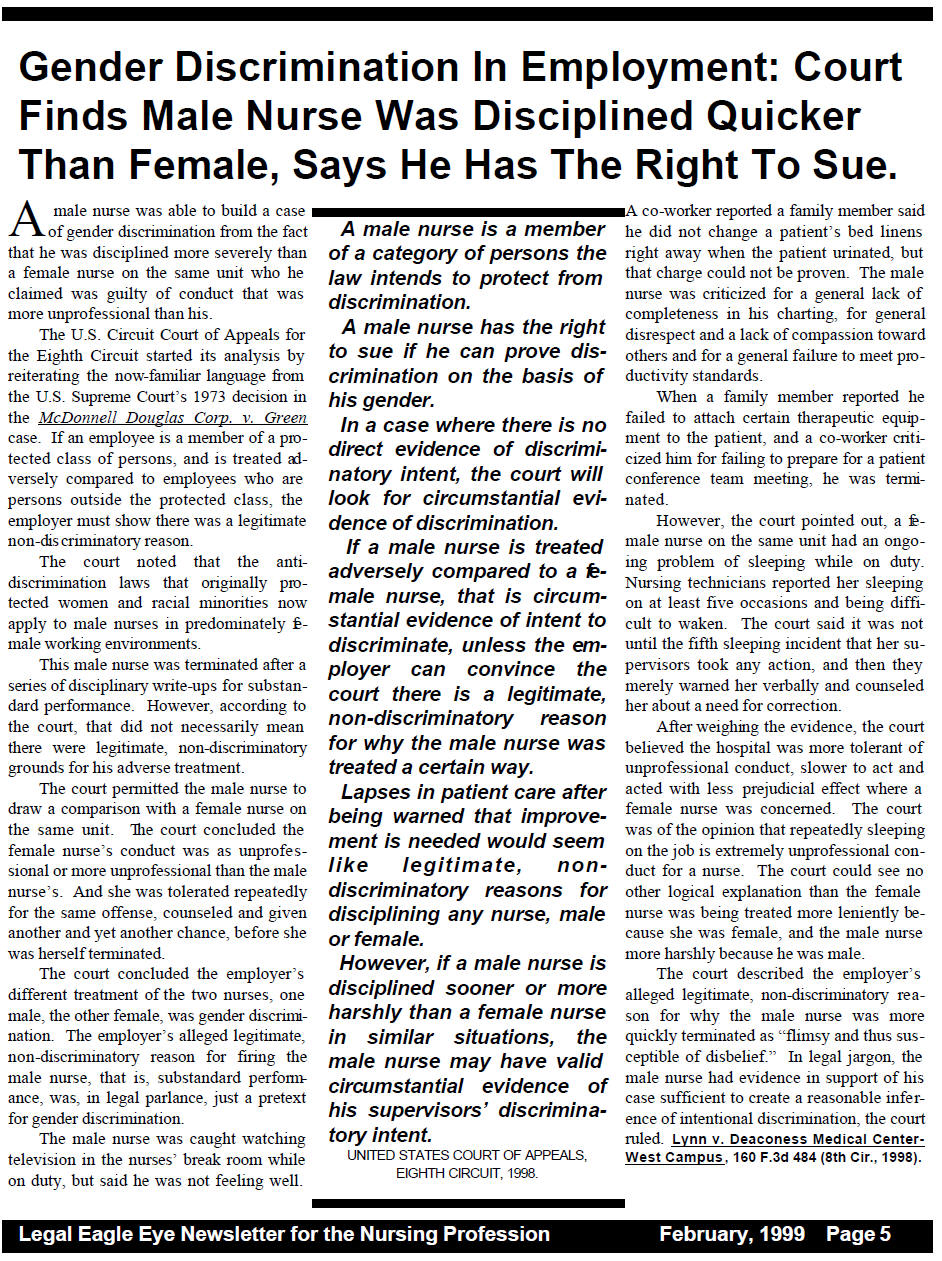
Gender Discrimination: Male Nurse Disciplined Quicker, Can Sue, Court Says
Quick Summary: Male nurses are a category of persons the law protects from discrimination.
A male nurse has the right to sue if he can prove discrimination on the basis of his gender.
In a case where there is no direct evidence of discriminatory intent, the court will look for circumstantial evidence of discrimination.
If a male nurse is treated adversely compared to a female nurse, that is circumstantial evidence of intent to discriminate, unless the employer can convince the court there is a legitimate, non-discriminatory reason for why the male nurse was treated a certain way.
Lapses in patient care after being warned that improvement is needed would seem like legitimate, non-discriminatory reasons for disciplining any nurse, male or female.
However, if a male nurse is disciplined sooner or more harshly than a female nurse in similar situations, the male nurse may have valid circumstantial evidence of his supervisors’ discriminatory intent.
UNITED STATES COURT OF APPEALS, EIGHTH CIRCUIT, 1998.A male nurse was able to build a case of gender discrimination from the fact that he was disciplined more severely than a female nurse on the same unit who he claimed was guilty of conduct that was more unprofessional than his.
The U.S. Circuit Court of Appeals for the Eighth Circuit started its analysis by reiterating the now-familiar language from the U.S. Supreme Court’s 1973 decision in the McDonnell Douglas Corp. v. Green case. If an employee is a member of a protected class of persons, and is treated adversely compared to employees who are persons outside the protected class, the employer must show there was a legitimate non-discriminatory reason.
The court noted that the anti-discrimination laws that originally protected women and racial minorities now apply to male nurses in predominately female working environments.
This male nurse was terminated after a series of disciplinary write-ups for substandard performance. However, according to the court, that did not necessarily mean there were legitimate, non-discriminatory grounds for his adverse treatment.
The court permitted the male nurse to draw a comparison with a female nurse on the same unit. The court concluded the female nurse’s conduct was as unprofessional or more unprofessional than the male nurse’s. And she was tolerated repeatedly for the same offense, counseled and given another and yet another chance, before she was herself terminated.
The court concluded the employer’s different treatment of the two nurses, one male, the other female, was gender discrimination. The employer’s alleged legitimate, non-discriminatory reason for firing the male nurse, that is, substandard performance, was, in legal parlance, just a pretext for gender discrimination.
The male nurse was caught watching television in the nurses’ break room while on duty, but said he was not feeling well. A co-worker reported a family member said he did not change a patient’s bed linens right away when the patient urinated, but that charge could not be proven. The male nurse was criticized for a general lack of completeness in his charting, for general disrespect and a lack of compassion toward others and for a general failure to meet productivity standards.
When a family member reported he failed to attach certain therapeutic equipment to the patient, and a co-worker criticized him for failing to prepare for a patient conference team meeting, he was terminated.
However, the court pointed out, a female nurse on the same unit had an ongoing problem of sleeping while on duty. Nursing technicians reported her sleeping on at least five occasions and being difficult to waken. The court said it was not until the fifth sleeping incident that her supervisors took any action, and then they merely warned her verbally and counseled her about a need for correction.
After weighing the evidence, the court believed the hospital was more tolerant of unprofessional conduct, slower to act and acted with less prejudicial effect where a female nurse was concerned. The court was of the opinion that repeatedly sleeping on the job is extremely unprofessional conduct for a nurse. The court could see no other logical explanation than the female nurse was being treated more leniently because she was female, and the male nurse more harshly because he was male.
The court described the employer’s alleged legitimate, non-discriminatory reason for why the male nurse was more quickly terminated as "flimsy and thus susceptible of disbelief." In legal jargon, the male nurse had evidence in support of his case sufficient to create a reasonable inference of intentional discrimination, the court ruled. Lynn v. Medical Center, 160 F.3d 484 (8th Cir., 1998).